
The Competition Bureau's enforcement posture toward influencer marketing tightened materially in 2024–2025, the CMCC industry-self-regulation guidelines were updated in late 2025, and Quebec piled additional consumer-protection layers on top. The compliance bar for Canadian influencer campaigns is higher than most brands and creators realize, and the penalties for getting it wrong have grown teeth.
The federal floor: Competition Act
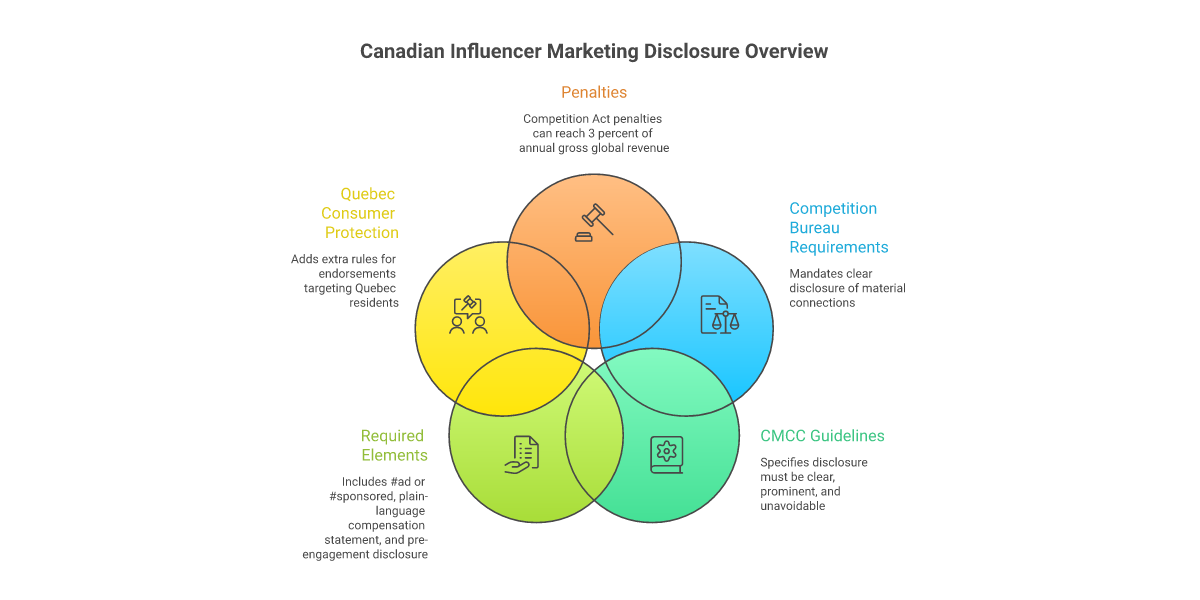
Material connections between an advertiser and an influencer must be disclosed clearly and prominently. "Material" includes paid partnerships, free product, affiliate commission, and any ongoing brand relationship. The Competition Bureau's position is that disclosure must be unavoidable to a reasonable consumer scanning the post — burying #ad in the fifth line of a 14-hashtag pile does not satisfy. Penalties under the Competition Act now reach 3 percent of annual gross global revenue.
CMCC guidance: the practical interpretation
The Canadian Marketing Council's influencer-marketing guidelines translate the Act into operational rules: hashtag #ad or #sponsored at the start of caption text, plain-language statement of compensation in video descriptions, on-screen overlay for video content, disclosure before any link-out or call-to-action. The guidelines aren't law, but the Competition Bureau cites them as evidence of reasonable industry practice.
Quebec adds another layer
Influencer content directed to Quebec residents falls under Quebec's Consumer Protection Act in addition to federal rules. The OPC has investigated cases where French-language disclosure was missing or weaker than the English equivalent. For brands running cross-Canada campaigns, the safe posture is full bilingual disclosure on Quebec-distributed content, with disclosure language reviewed by counsel for any large campaign.

What Canadian agencies should put in client contracts
Contracts with influencers should specify required disclosure language, placement (caption start, on-screen overlay, video description), and consent for the brand to audit live content. Contracts should also reserve the right to require corrections within a defined window. This protects both the brand and the creator — the Competition Bureau's enforcement actions have generally focused on advertisers, but creator reputational exposure compounds when disclosure breaks down. See our approach to honest representation for the principle this is built on.
Keep reading
Browse the full blog index, jump to our resources, or look up terms in the glossary.