
Gmail and Yahoo's bulk-sender requirements quietly raised the floor on what compliance looks like for any Canadian organization sending more than a few thousand emails per month. The rules aren't new in 2026, but enforcement keeps tightening, and the senders we audit who haven't completed the work are seeing measurable inbox-placement degradation that they often misattribute to "deliverability gremlins." It's almost always one of five things.
The five must-haves
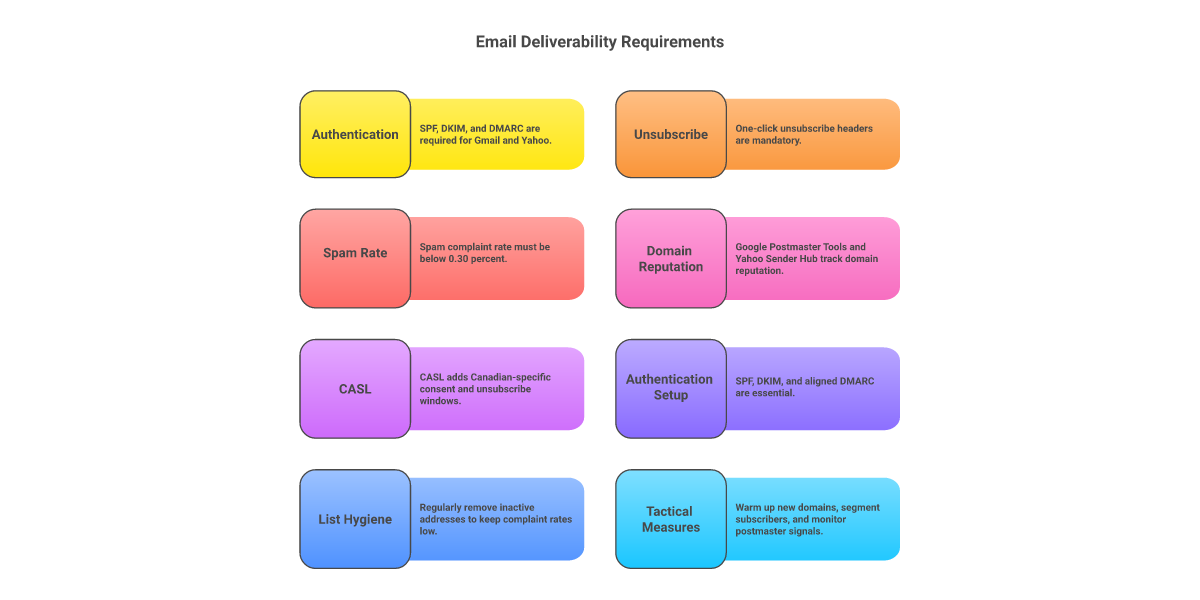
- SPF and DKIM authentication on every sending domain — both, not just one. Gmail explicitly requires both for bulk senders.
- DMARC policy of at least p=none, aligned with the From-domain. Quarantine or reject is better.
- One-click unsubscribe header (List-Unsubscribe with HTTPS POST) so Gmail and Yahoo can offer the inbox-level unsubscribe button.
- Spam complaint rate below 0.30 percent — measured monthly via Google Postmaster Tools and Yahoo Sender Hub.
- Working physical mailing address and clear sender identification in every message — also CASL requirements, so this is double duty.
Google's bulk sender guidelines document the exact thresholds.

The Canadian-specific overlay
CASL adds a separate compliance track that doesn't directly affect inbox placement but does affect legal exposure. The deliverability rules and CASL are independent; you can pass deliverability checks and still violate CASL if your consent records are weak. See our CASL coverage for that side. Practical implication: design your program to satisfy the strictest of the three (Gmail, Yahoo, CASL) and the easier ones come along automatically.
Postmaster monitoring is the leading indicator
Most senders only look at deliverability when something visibly breaks — campaign opens crater, customer complaints spike. Domain reputation in Postmaster Tools is the leading indicator: it usually softens before campaign metrics do. Check it weekly, not just when there's a problem. The pattern: reputation drifts from "high" to "medium" first, complaint rate creeps from 0.10 to 0.20 percent, and only then does inbox placement collapse.
List hygiene is unsexy and decisive
Removing inactive subscribers — addresses that haven't opened in 6 to 12 months — feels like throwing list size away. The data we see across member-agency client programs says the opposite: active-only campaigns have higher engagement, lower complaints, and better inbox placement, which compounds into more conversions per send than larger-but-stale lists deliver. Sunset unengaged addresses on a regular cadence rather than letting them accumulate.
Published by CanadianInternetMarketingAssociation.com, 10 May 2026. Postmaster thresholds change occasionally — verify current Gmail and Yahoo guidance before architecting compliance.
Keep reading
Browse the full blog index, jump to our resources, or look up terms in the glossary.