
Schema markup has been through a few cycles of "this still works" and "this just got deprecated." We audit roughly 50 Canadian member-agency client sites' structured data per year, and the working set in 2026 is narrower than it used to be — but the markup that does still earn rich results is more valuable per implementation than ever, because the surfaces it feeds (Google, AI Overviews, AI assistants) all read the same JSON-LD.
What still earns rich results
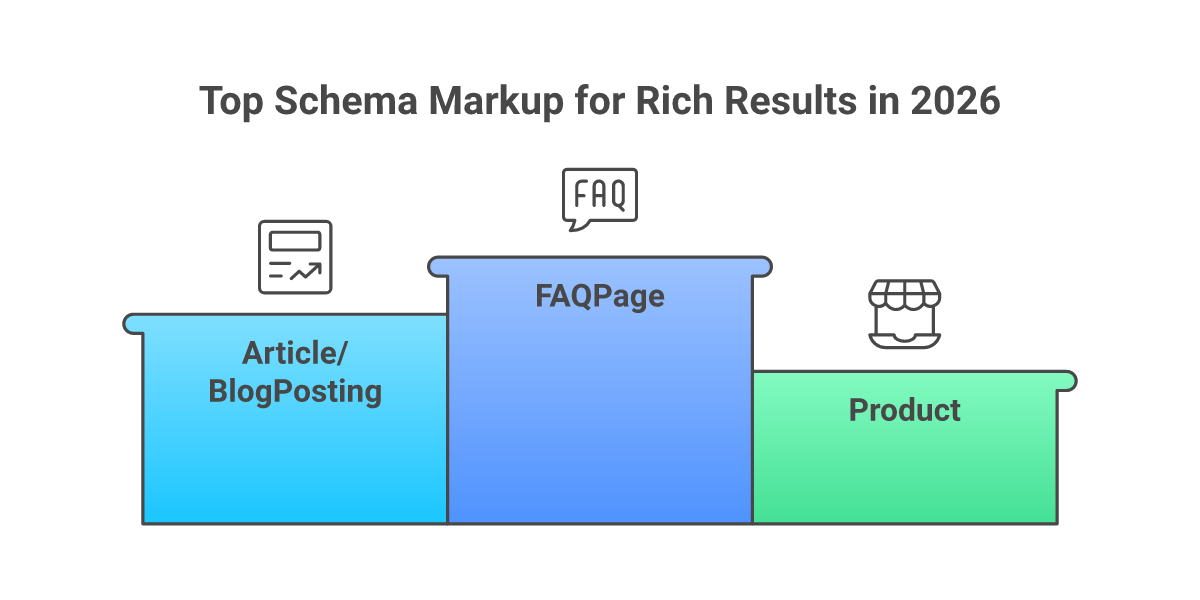
FAQPage retains rich-result eligibility for institutional and educational content even after the broader 2023 deprecation, particularly for government, association, and recognized publisher sites. Article and BlogPosting with author, datePublished, image, and inLanguage continue to drive News and Discover surfaces. Product with reviews, price, availability, and currency remains foundational for shopping panels. LocalBusiness with hours, address, geo coordinates, and serviceArea drives Map Pack details. Course, Recipe, HowTo, and Event retain category-specific rich-result eligibility per Google's Search Gallery documentation.
What's effectively deprecated
HowTo and FAQPage rich snippets were largely sunsetted for general-purpose pages in 2023. They still validate; they just don't appear as rich results for typical commercial sites. Most generic FAQ implementations today add no SERP visibility. The exception we still see ranking: well-structured FAQPage on association, government, and education-domain sites where the institutional context matches Google's residual eligibility.
The audit findings that recur
In our structured-data audits, the failure patterns are remarkably consistent. Article schema missing image, datePublished, or inLanguage. Product schema with stale availability values. LocalBusiness schema with priceRange copied from a US template (inappropriate for Canadian context). Multiple JSON-LD blocks with conflicting @id values. Mismatch between visible content and structured data — Google's spam policies treat this as a problem. Validation with both the Rich Results Test and the Schema.org validator catches most issues; only the Schema.org validator catches some of the cross-entity referential errors.

Why structured data matters more than rich results suggest
Even when a particular schema type doesn't earn a SERP rich result anymore, AI search systems and assistants read the same JSON-LD when they decide which sources to cite. A page with clear Article schema, a real author entity, and traceable publisher information cites more reliably in AI Overviews and Perplexity than an equivalent page without it. The "rich results" surface is shrinking; the "AI citation" surface is growing. Both are powered by the same markup.
The audit sequence we use
Crawl the site to inventory existing JSON-LD blocks, validate each block against the Schema.org spec, then re-validate against Google's Rich Results Test for eligible types. Flag conflicting @id usage, missing required properties, and visible-vs-markup mismatches. Prioritize fixes for high-traffic templates first. Member agencies should report findings with clear effort-and-impact framing, in the spirit of our Transparent Pricing standard.
Published by CanadianInternetMarketingAssociation.com, 10 May 2026. Findings are based on aggregate observations across Canadian agencies.
Keep reading
Browse the full blog index, jump to our resources, or look up terms in the glossary.