
Canadian marketing agencies and in-house operations teams that have been quietly running AI agents — for content production, lead qualification, customer-support triage, reporting, and internal research — are reaching the point where the "harness" they run those agents inside matters more than the model. Three open-source harnesses have emerged as the practical options in 2026: Hermes from Nous Research, OpenClaw from the community that built around it, and NemoClaw, NVIDIA's enterprise-security wrap over OpenClaw. Each makes different tradeoffs that show up in how well it fits a Canadian marketing operation.
What an agent harness actually is
A harness is the scaffolding around a language model that turns it from a chatbot into something that does work — loops, sub-agents, tool calls, memory across sessions, sandboxing, scheduling, and the connectivity to the systems the agent is supposed to act on. The model is interchangeable; the harness is where your operational risk and your team's day-to-day experience live. For marketing teams, "the harness" is usually what determines whether your AI workflow stays automated for six months or quietly degrades after week three.
Hermes — Nous Research's learning-first runtime
Hermes was released by Nous Research in February 2026 and crossed 140,000 GitHub stars in under three months. Its distinguishing feature is a built-in learning loop: after the agent completes a complex task, it extracts the workflow as a reusable skill, refines that skill across subsequent invocations, and builds a persistent model of the user it's working with. Sub-agent delegation is first-class — the parent agent spins up isolated workers for parallel workstreams, each with their own iteration budget — and there is a documented seven-layer security model that was designed in from the start rather than bolted on later.
For Canadian marketing teams, Hermes is the fit when you want one assistant that improves at your team's workflows over time. Drafting weekly client reports, qualifying inbound leads against an ICP, running a content-research loop with a citation gate at the end — these are the repeatable patterns where Hermes' skill-extraction shines. The tradeoff is that it's runtime-first and CLI/desktop-oriented; if your team needs the assistant to live inside Slack or Telegram conversations, you'll be doing more integration work.
OpenClaw — breadth and a messaging-first design
OpenClaw is the other dominant 2026 harness and the one with the largest integration surface — it currently supports the most third-party tools, the most messaging channels (Slack, Telegram, Discord, WhatsApp, Teams), and the largest community library of pre-built skills. Where Hermes wraps a learning loop around a CLI agent, OpenClaw wraps an agent around a messaging gateway. The multi-agent architecture lets a single deployment run several distinct agents, each with its own channel and persona — useful for agencies running an internal-ops assistant, a client-facing FAQ bot, and a content-research agent under one roof.
The historical knock on OpenClaw was security. Its permissive default model evolved reactively after public incidents — sandboxing and approval flows are present now, but the security posture was retrofitted. For Canadian agencies handling client data covered under PIPEDA or Quebec's Law 25, that history matters: anything an OpenClaw agent touches must be assumed reachable by the agent, and your data-handling controls need to live above the harness.
NemoClaw — NVIDIA's enterprise layer on top of OpenClaw
NemoClaw was announced at NVIDIA GTC in March 2026 as a response to exactly that enterprise-security gap. It's not a replacement for OpenClaw — it's a stack that wraps it. NemoClaw adds three controls: a kernel-level sandbox that runs the agent under a deny-by-default policy, an out-of-process policy engine that compromised agents cannot override, and a privacy router that keeps sensitive data on local NVIDIA Nemotron models while allowing complex reasoning to be routed to cloud frontier models. It installs with a single command on RTX-class hardware (consumer or workstation).
For Canadian marketing organizations holding client PII, financial data, or anything covered under provincial privacy law, NemoClaw is the harness layer that makes deploying OpenClaw-style automation defensible in a procurement review. The tradeoff is hardware dependence — you're committing to NVIDIA RTX infrastructure on-premise or workstation-class — and you're working with what NVIDIA itself documents as an alpha-stage stack.
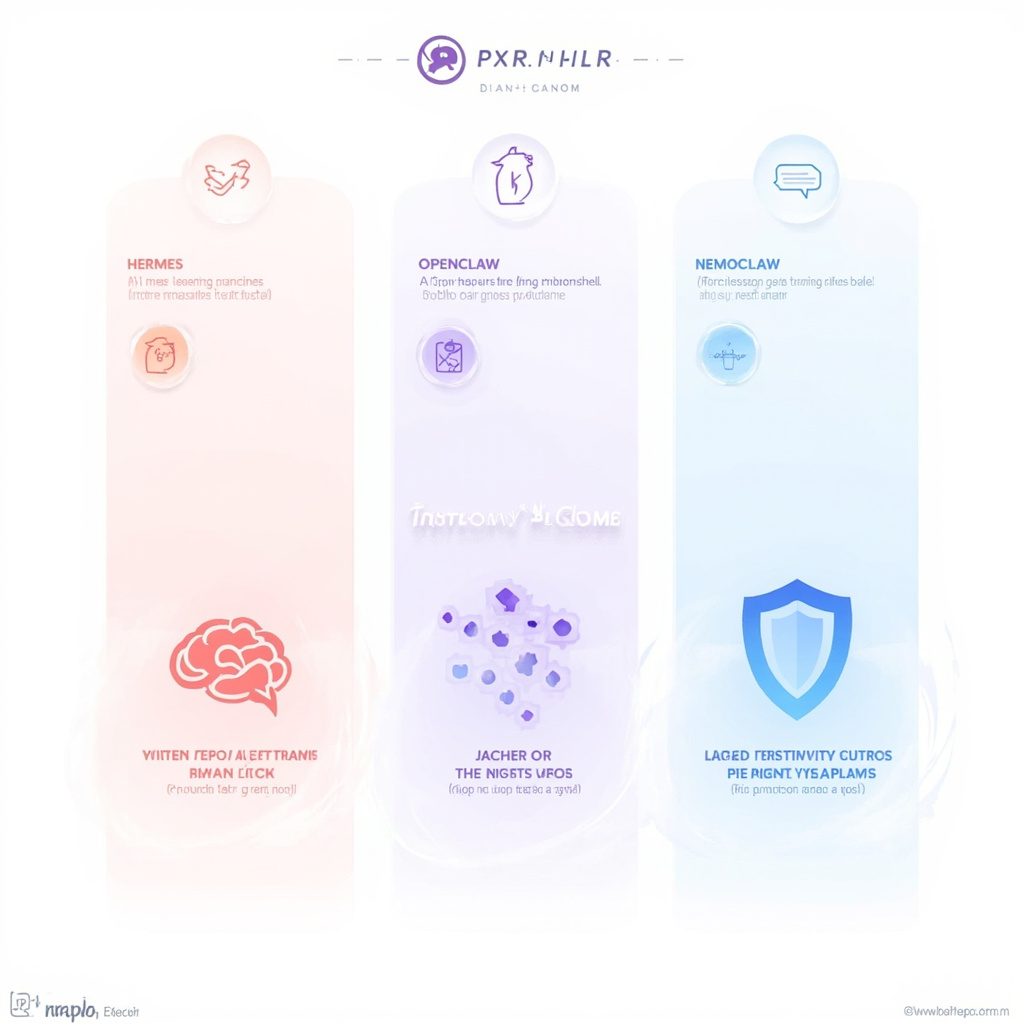
Side-by-side: which harness fits which Canadian marketing operation
- Solo operators and small agencies (1–5 people) running a CLI-driven content or reporting workflow: Hermes. The learning loop returns time within weeks.
- Mid-sized agencies (5–25) coordinating client-facing chat and internal ops across Slack/Telegram/Discord: OpenClaw. The breadth and channel coverage carry the operation.
- Agencies with enterprise clients, regulated-industry clients, or data covered under PIPEDA / Quebec Law 25: NemoClaw on top of OpenClaw. The structural sandbox is what makes the procurement conversation possible.
- In-house marketing teams inside Canadian enterprises already standardized on NVIDIA infrastructure: NemoClaw, with the privacy router pointed at on-prem Nemotron for anything customer-identifiable and cloud models for general reasoning.
- Teams that want to mix: nothing prevents running Hermes for the team's internal research/skill workflows alongside an OpenClaw or NemoClaw deployment for client-facing or production work — they don't overlap operationally.
The Canadian compliance angle most reviews skip
None of these harnesses solve your compliance posture on their own. PIPEDA's accountability principle still puts the responsibility on the organization deploying the agent, regardless of how good the sandbox is. Quebec's Law 25 adds explicit-consent requirements for any automated decision-making that produces legal or similarly significant effects — including, in some readings, automated content moderation or lead scoring used in hiring or credit-adjacent contexts. The harness gives you the technical primitives to keep data local, to log what the agent did, and to constrain what it can reach — but the governance work (data-handling policy, vendor disclosure, consent mechanics, retention windows) sits above the harness and stays your responsibility.
Practically: Canadian agencies running OpenClaw or NemoClaw should keep a written record of which agents touch which client data, route any cross-border model calls (US-based frontier models) through the privacy router or equivalent, and have a documented kill switch. Hermes deployments should treat the persistent-memory store as PII for retention purposes — what the agent remembers about the team is itself a data-handling concern.
Where this is heading
The harness layer is moving faster than the model layer right now, and the gap between "running an LLM in a script" and "running an agent in production" keeps widening. For Canadian marketing teams, the practical move in 2026 is to pilot one harness against one well-scoped internal workflow (weekly reporting, lead enrichment, content drafting with a human review gate) and measure the operational lift before scaling out. The harness you start with is more reversible than the team habits you build around it — pick for fit, not for hype, and assume you'll be running something different in 18 months regardless.
Published by CanadianInternetMarketingAssociation.com on 22 June 2026. General guidance, not legal advice — consult counsel for privacy and compliance questions specific to your situation.
Keep reading
Related: Building Canadian content authority in the AI search era, AI content disclosure for Canadian publishers, and the Canadian privacy law patchwork. Or browse the full blog index.